
Nursing at Camp
As I reflect back on my years at camp, I have the same feeling every year around this time about camp. Warmth. It brings joy to my heart because of the community at camp. Our camp community creates a feeling of warmth by wrapping us in a sense of belonging, shared care, and connection. An important part of the community that has always been there is the nurse.
Over the course of my Senior Staff career on camp staff has pretty much entirely been in the nurses cabin. On our current property the nurses cabin is pretty central, able to get to any part of the property within a couple of minute casual walk (within a minute if running at a healthy speed). Within the nurses cabin there is a living room area with a couch, table with the all important walkie talkie on it and several cupboards to store camper medication and over the counter medication and first aid supplies. As well in the back of the cabin there is a bathroom and a couple of bunk beds for tired or sick campers if needed. Overall a very cozy cabin.
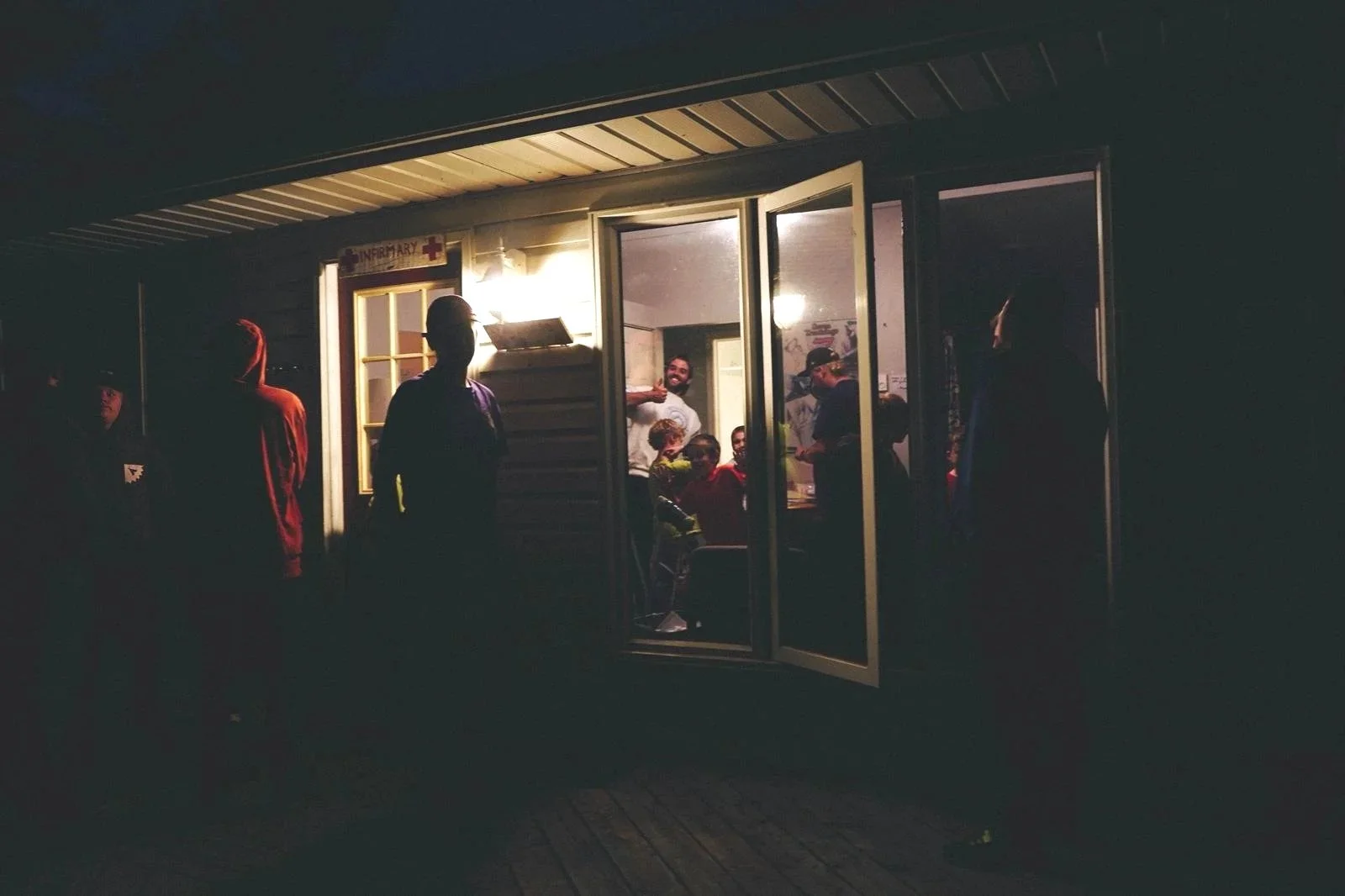
Light Night Traffic at the Nurse’s Cabin for Nighttime Meds
Being the nurse, you are not fully a part of the program at camp unfortunately. It feels on some days that you are a third party observer. Generally a day as the nurse involves giving out camper medications (most common around breakfast and bed time), making rounds to activities making sure all the campers are drinking water, and making sure all of them are wearing proper clothes (sunscreen, bug spray). Also being available to answer questions the counselors have. Over the course of an average day at camp the nurse will more than likely be cleaning and bandaging up a few scrapes and cuts for campers who fell off a bike or broke a toenail playing soccer in flip flops, and don't forget about removing splinters and hitting their finger with a hammer at wood craft. Another common thing to see is what I call the frequent flyers, the boys who are either accident prone, or the kids who are “sick”.
A lot of the time the kids who are “sick” come to the nurses for some peace and quiet. Almost as if the nurse transforms into a some form of therapist to chat to. These kids tend to arrive at times of the day where there may be a bit of down time, like in between activities or immediately before meals when sing song tree is in full swing. One week there was a boy who got a good scrape on his knee while playing land section kick ball on the first full day, and his counsellor brought him to the nurses cabin to get patched up. Whilst I was cleaning the scrape we got to casually chatting, about food or activities, something along those lines and when I finished I sent him on his way and didn’t think much of it.
Until the next day when he arrived again at practically the exact same time, complaining of how his finger hurts. Turns out nothing was wrong, he just wanted to chat. It turned into a daily routine where he would show up complaining of nothing in particular and wanted to chat. These little chats only lasted about 5-10 minutes and generally were about stuff he was enjoying or problems he was having with the other boys in his cabin, or he would give me unsolicited advice about how my hair was a mess. Another week a boy came to the nurses cabin complaining about a “tummy ache”, during rest period. As I was asking him about it, he came out straight and said it wasn’t really hurting and he just wanted to get out of the cabin as it was too loud. Not expecting that, we started chatting more about life. Again this became a daily routine of him complaining of nothing in particular and just coming for a break in the action.
Having campers like these is a common occurrence, where they come to the nurse for a listening ear rather than a band aid. There always will be the time to treat these campers with the care and compassion that all these kids deserve whether the kid fell off their bike and hit their head or they are trying to get out of going to bed at bed time. It's a matter of prioritizing. As well at meal times it is important to get all the campers to eat, and drink. This can be communicated by talking to section heads to stress its importance to counselors and doing it at meals and during line ups before meals. There are always a few picky eaters and kids with allergies during the group of boys. It is important to communicate directly with the campers about these so you can find out what works.
Commonly the nurse will also have to take care of the campers psychological needs as well. It is incredibly important to provide a positive psychological place for the campers to have because studies to date have shown that positive psychological interventions can reduce behavioural and biological processes that have a direct link to health. (“Positive Psychology and Physical Health: Research and Applications”). Also having a place where any one can come and have a chat about problems, can reduce stress. In my experience if someone comes to chat about issues its important to keep the conversation solution focused. So the person can leave feel as if there was some form of resolution.
Communication is probably the most important part of being the nurse, whether it be to who you communicate with and how you communicate. The way you communicate matters because all the campers and staff need to feel comfortable coming to you about any medical or psychological needs. It needs to be caring, compassionate and truthful. An important part of the nurse is to help campers and staff about how best to take care of their own physical and mental health. Whether it be giving a bit of harsh advice to a counselor that they need to go to bed at a reasonable time rather than staying up until 2 am at the CC with their buddies, or providing an open ear to a camper who is having a rough time feeling home sick at midnight.
One thing I was told in my first year at camp and has stuck with me ever since, and I made a promise to myself that I will never forget. Camp is for the kids. They will always be the reason we come back to camp every single year. The kids deserve the world and every ounce of compassion we have. Camp is a place that I originally thought of as just a job in my first year and now it is home. Camp will always be home no matter where you are.
Work Cited
“Positive Psychology and Physical Health: Research and Applications.” PubMed Central, https://pmc.ncbi.nlm.nih.gov/articles/PMC6124958/. Accessed 7 December 2025.